Leaderboards
  Become a Member
  Shop
Shop  Trade In
 Course Spotlight
The Riviera Country Club at 100: History, Hogan’s Alley & a Timeless Championship Legacy
By Brendon Elliott, PGA
Published on
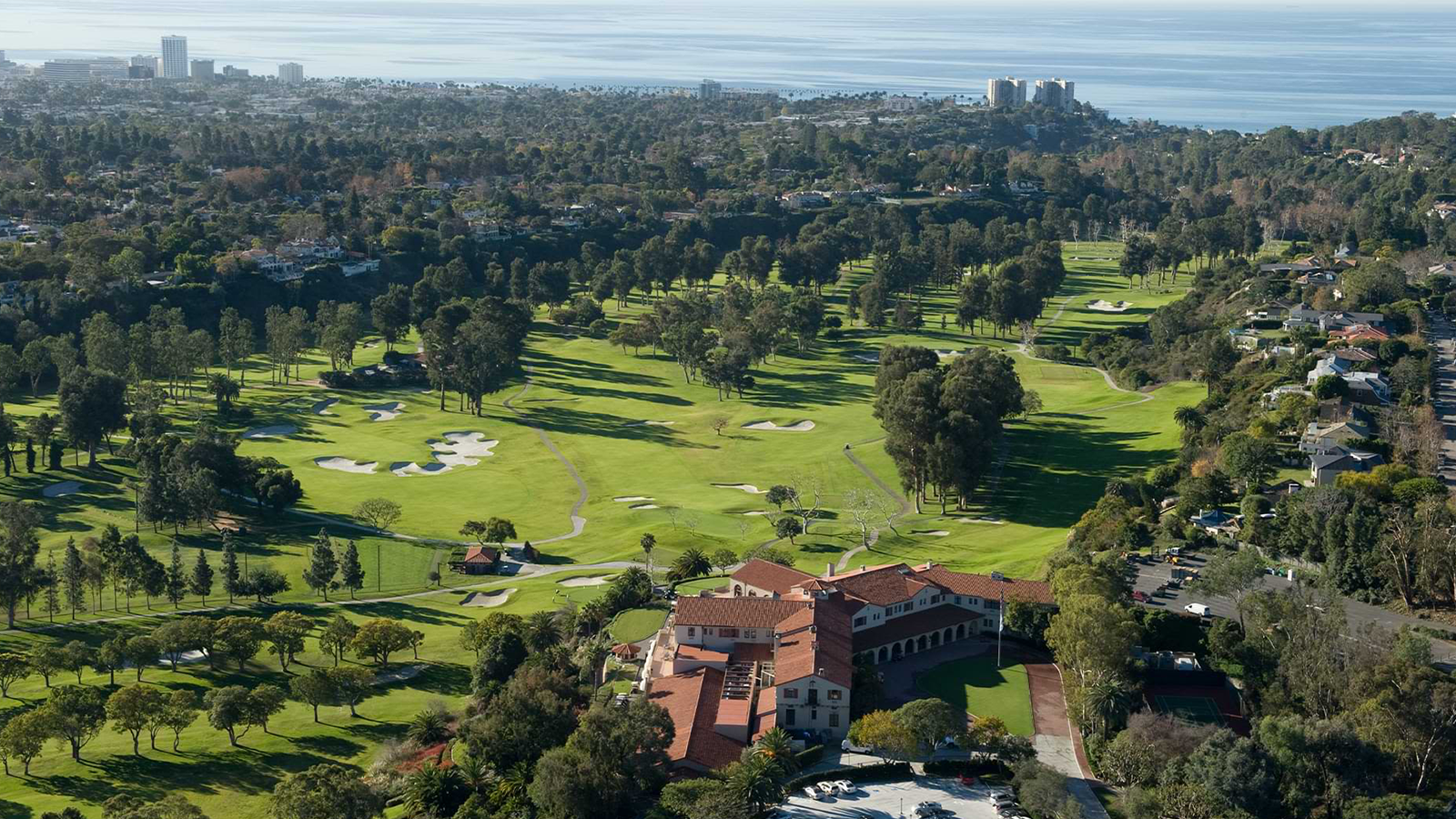
There’s something magical about driving up Capri Drive in Pacific Palisades. The unassuming brown brick sign at the corner of Sunset Boulevard doesn’t prepare you for what lies beyond those gates. But once you’re inside, the Spanish Revival clubhouse comes into view, and you understand immediately: This is hallowed ground.
The Riviera Country Club turns 100 this year, and it’s hard to think of another American golf course that has maintained such consistent excellence for an entire century. From the moment it opened in 1927, Riviera has been the gold standard for West Coast championship golf, hosting the 1983 and '95 PGA Championships.
Built Without Compromise
The story begins in 1926 when members of the Los Angeles Athletic Club decided they wanted a golf course. Not just any golf course, but the best money could buy. They found their land in Pacific Palisades, a valley just over a mile from the Pacific Ocean, and paid $264,500 for a property appraised at $1.5 million.
Then they brought in George C. Thomas Jr., the amateur architect who would create his masterpiece. The budget was staggering for the time: $250,000 to build the course, nearly four times the average cost of courses built in that era. The clubhouse added another $450,000.
Thomas spent 18 months perfecting his design, creating 15 different iterations before settling on the final layout. Alister Mackenzie, who would go on to design Augusta National, visited during construction and called it “as nearly perfect as a man could make it.”
A century later, those words still ring true.
Hogan’s Alley
If Riviera has a patron saint, it’s Ben Hogan. The legendary ball-striker won the Los Angeles Open at Riviera twice and captured the 1948 U.S. Open there. His dominance was so complete that the course earned the nickname “Hogan’s Alley.”
Hogan called the par-3 fourth hole “the greatest par-3 in America.” He wasn’t prone to hyperbole, which makes the compliment all the more meaningful.
The 1950 Los Angeles Open might be the most dramatic tournament ever played at Riviera. Hogan, still recovering from a near-fatal car accident the year before, battled Sam Snead through brutal weather conditions. Officials had to cancel and replay an entire round. When Hogan and Snead tied, their playoff was postponed a week due to more rain. Snead eventually won, but the tournament became the stuff of legend.
A Course That's Timeless
What makes Riviera special isn’t just its history. It’s how well the design has held up against modern equipment and modern athletes. The course plays just under 7,400 yards for The Genesis Invitational, but it was already over 7,000 yards for that 1948 U.S. Open.
The routing hasn’t changed. The strategic intent of each hole remains intact. That’s a testament to Thomas’s genius.
The par-3 sixth hole, with its bunker in the middle of the green, remains one of golf’s most distinctive holes. The short par-4 10th tempts players to drive the green but punishes the slightest miscalculation. And the uphill, blind tee shot on 18 creates drama every single time.
“It’s the best layout on Tour,” says Max Homa, who was born in Burbank but grew up in Valencia, California, and won at Riv in 2021. “It’s got the star power of the actual city, and it has that City-of-Angels feeling once you’re at the golf course. It’s got it all.”
Maintaining Excellence
Keeping a 100-year-old course in championship condition requires more than just mowing fairways and raking bunkers. It demands a deep understanding of Thomas’s original vision and the expertise to honor it while meeting modern standards.
Marshall Dick has been Riviera’s golf course superintendent for 14 years, overseeing a team of 32 agronomy employees who work year-round to maintain the course’s pristine conditions. During tournament weeks, they’re joined by 45 tournament volunteers who help ensure every detail is perfect.
But maintenance is only part of the equation. Riviera has undergone several careful renovations over the decades, each designed to restore rather than reinvent. Ben Crenshaw and Bill Coore worked on the course in 1992, while Tom Fazio has contributed multiple restoration projects over the years, always with an eye toward preserving Thomas’s strategic intent.
The work continues today. In the summer of 2024, the fourth hole underwent restoration to recapture its original character. The 18th tee complex was also completed, enhancing one of golf’s most dramatic finishing holes. A year earlier, in 2023, the green contours on the 10th and 15th holes were restored to their historical specifications.
These aren’t cosmetic changes. They’re archaeological digs into golf architecture, uncovering what Thomas intended and bringing it back to life. The goal isn’t to make Riviera harder or easier; it’s to make it more authentically Riviera.
The Future Looks Bright
Riviera has some exciting days ahead. The club will host the U.S. Women’s Open in 2026 and golf at the 2028 Summer Olympics in Los Angeles. In 2031, it will host the U.S. Open for just the second time.
For a course that has already given us 100 years of unforgettable golf, that’s saying something. The Riviera Country Club isn’t just a monument to the past. It’s a living, breathing testament to what great architecture can achieve.
PGA of America Golf Professional Brendon Elliott is an award-winning coach and golf writer. Read his recent “The Starter” on R.org and his stories on Athlon Sports. To stay updated on his latest work, sign up for his newsletter and visit OneMoreRollGolf.com.