Leaderboards
  Become a Member
  Shop
Shop  Trade In
 Course Spotlight
Course Guide to Hazeltine National: Inside One of America's Great Championship Venues
By Tony L. Starks
Published on
The mission has never changed.
Former USGA President Totton P. Heffelfinger helped found Hazeltine National Golf Club with a singular vision: create a golf course capable of hosting the game's biggest championships. Not occasionally. Consistently.
More than six decades later, the record speaks for itself.
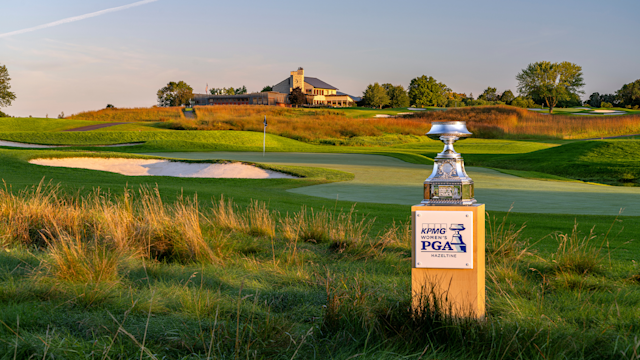
Since opening in 1962, Hazeltine has hosted men's and women's U.S. Opens, men's and women's PGA Championships, two U.S. Amateurs and the Ryder Cup (with another on the horizon in 2029, which will make it the first U.S. venue to host the biennial event multiple times). Now, it’s set to host its second KPMG Women's PGA Championship.
For all the attention Hazeltine receives for its championship history, there's an often-overlooked detail woven into the club's DNA.
The first major championship ever contested alongside Lake Hazeltine was the 1966 U.S. Women's Open.
"The thing that I love about Hazeltine is 60 years ago they hosted their first major championship, which was a U.S. Women's Open," says PGA Teaching Professional Jennifer Huber. "Hazeltine has a history of supporting women's golf. So it's nothing new for Hazeltine to showcase the women’s game at the highest level."
Where women’s majors have recently taken center stage at locations historically reserved for the men, such as Riviera, Pebble Beach and Aronimink, Hazeltine has championed it from the start.
The world's best women golfers return for the 2026 KPMG Women's PGA Championship, continuing the tradition. And according to the PGA Professionals who know Hazeltine best, that history matters.
"Our mission statement revolves around hosting national championships and providing a test for the game's greatest players," says PGA Head Professional Kyle Brandt. "The members understand that."
They understand it so well that every championship becomes a club-wide effort. Roughly half of the 1,500 volunteers required for this week's championship have ties to Hazeltine through membership, family or past involvement with the club.
When it comes to the course itself, what makes Hazeltine special isn't just that it's difficult, it’s the variety of ways it asks players to problem solve.
At first glance, the total distance doesn’t appear overwhelming for the modern game. This week’s KPMG Women's PGA Championship will be contested at approximately 6,600 to 6,700 yards, a similar setup to the 2019 championship won by Hannah Green.
“You would think the bombers would have an advantage, but if you look back at 2019 that really wasn’t the case. Hannah wasn’t among the longest hitters at the time, and you wouldn’t put Lizzette Salas or Danielle Kang in that category either (both finished top five),” says PGA Director of Instruction Michael Barge. "The key: You can't play this golf course from the rough."
Simple advice. Difficult execution.
The rough will be grown to approximately three inches for championship week, and Minnesota's early summer conditions have a habit of making it even more lush.
"The rough is going to be an issue," says Huber. "Things grow well here in Minnesota."
Equally as important as finding the fairway is finding the correct portion of it.
"There are some holes where you think you've hit a good drive, you've landed in the fairway, but they need to be aware of how the ball kicks," Huber explains. "Just because you landed in the fairway, there's a pretty good chance you could still end up in the rough or with an uneven lie."
That subtle distinction can quickly become a point of frustration for players, as Hazeltine rewards precision, not merely accuracy. And the challenge only intensifies on approach shots.
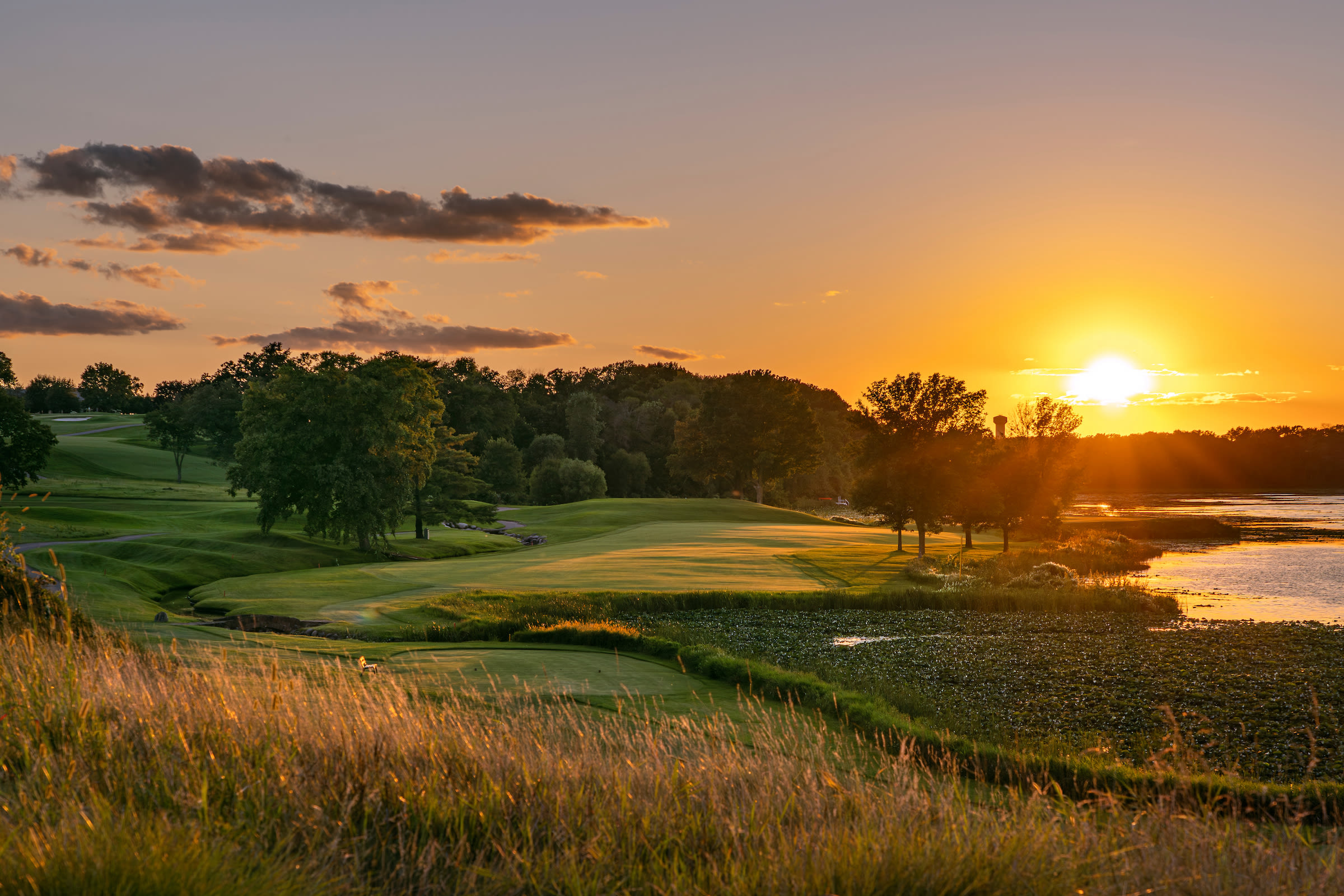
Robert Trent Jones Sr.'s original design – later refined by his son Rees Jones – created a course that places tremendous emphasis on positioning and trajectory control. Players must not only identify their target but understand how the golf ball will react once it lands.
The 10th hole is a perfect example.
The green slopes dramatically toward the back left corner. A seemingly conservative approach shot from the rough can land safely on the front right portion of the putting surface and roll all the way through the green to still find trouble.
The wind only complicates matters. Hazeltine sits on one of the highest points in Carver County and, with relatively few trees interrupting airflow and exposure to the lake, the course is rarely still.
"Don't be surprised," Huber says. "It's probably going to be windy."
That reality introduces another layer to the championship. Distance certainly helps, but history suggests it won't determine the winner. Instead, Hazeltine tends to reward players who control their golf ball, manage difficult conditions and possess the patience to accept par as a good score on many holes.
Which brings us to the back nine. Hazeltine’s closing stretch is capable of creating unforgettable moments – a clear sign of a great championship venue.
Brandt points first to the stretch beginning at the par-3 13th. "It's a long and demanding par 3 where par is always your friend," he says. “Players who find the center of the green and move on will gladly take a three, while those who miss their target can quickly be found scrambling to save par.”
Huber agrees.
When she recently played the hole from championship yardages alongside Nicole Felce, the PGA Assistant Professional at Countryside CC in Clearwater, Florida, who qualified for this year's field, even the longest players faced demanding approaches.
"She hits it a long way, and was still playing a hybrid into that hole," Huber recalls.
The 14th, a gettable par 4 of moderate length, offers a brief opportunity for recovery before players enter what Brandt describes as Hazeltine's gauntlet.
The final four holes – Nos. 15 through 18 – represent one of the most demanding finishing stretches in championship golf. The 15th asks players to balance aggression and restraint on a lengthy par 5.
No. 16, Hazeltine's signature hole, features a creek guarding the left side, Lake Hazeltine lurking on the right and wind sweeping across the peninsula green. Everything about it invites drama.
"It rewards commitment and execution while exposing any hesitation," says Brandt.
Pressure increases from there. The demanding par-3 17th offers a test of nerve, with a well-guarded green complex that features one of the course's most undulated putting surfaces.
All this before players arrive at the iconic finishing hole, where major championships, Ryder Cups and unforgettable moments – including Y.E. Yang's historic victory over Tiger Woods in the 2009 PGA Championship – have unfolded.
With grandstands surrounding the green and a championship hanging in the balance, Hazeltine's 18th has a way of revealing exactly who can handle the moment.
Yet for spectators hoping to witness those moments throughout the day, Brandt and Barge point to a few strategic viewing locations. Brandt believes the championship could hinge on the stretch from 12 through 14 before carrying through the closing holes.
With that in mind, Barge recommends you position yourself behind the 13th tee. From there, spectators can watch approaches into 12, action on the par-3 13th and tee shots on both 14 and 15 without moving more than a few steps.
"I can't think of a different spot where you can see that many holes," he says.
It's fitting advice because Hazeltine itself is a study in perspective. Sixty years after welcoming the U.S. Women's Open for its first major championship, the club remains remarkably faithful to its original purpose: providing a stage worthy of the game's greatest players and biggest moments.
This week, another major winner will cement their name among Hazeltine’s championship history.