Leaderboards
  Become a Member
  Shop
Shop  Trade In
 Course Spotlight
TPC Deere Run Course Guide: Key Holes, Strategy and History
By Brendon Elliott, PGA
Published on
There is something wonderfully honest about TPC Deere Run.
It does not try to overwhelm players with brute force. It does not hide behind manufactured difficulty or ask for survival golf. Instead, the longtime home of the John Deere Classic asks a different question: Can you keep attacking when the golf course keeps inviting you to attack?
That is the charm, and the challenge, of this D.A. Weibring-designed layout in Silvis, Illinois. TPC Deere Run has hosted the John Deere Classic since 2000, sits just miles from John Deere’s world headquarters and was built specifically to give the Quad Cities a PGA Tour home of its own. The event dates back to 1971, but Deere Run gave it a distinct identity: Midwestern, welcoming, charitable and sneaky dramatic.
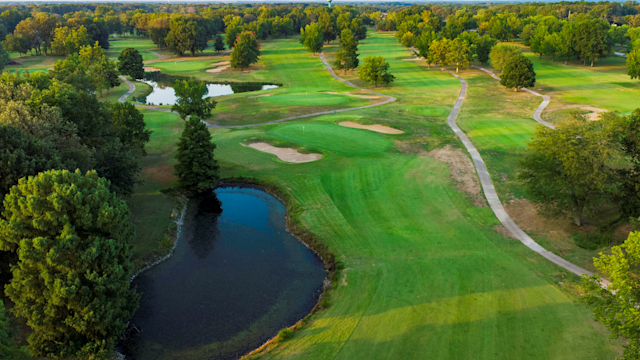
The setting helps tell that story. TPC Deere Run was built on the site of a former Arabian horse farm, and Weibring used the rolling land, wooded ravines and the Rock River corridor to create a course that feels far more natural than forced. The club lists the course as a par-71 layout of more than 7,200 yards, but the yardage alone misses the point. This is a shot-making course, not a power-only test.
That is why the John Deere Classic has become such a fascinating stop on the schedule. It can yield low scoring. It can produce first-time winners. It can launch players toward bigger stages. It can also expose the player who gets impatient, misses in the wrong spot or assumes birdies will come simply because everyone else is making them.
Deere Run gives players chances, but it rarely gives them permission to get careless.
A Course Built Around Movement
One of the first things players notice about TPC Deere Run is the elevation change. For a course in this part of the country, there is a surprising amount of movement from tee to green. Downhill tee shots, uphill approaches, sidehill lies and ravines all factor into club selection and target discipline.
That movement starts early. The first hole is a short par 4 with an uphill tee shot, a generous fairway and a green guarded by bunkers. It is not overly punishing, but it immediately asks players to control trajectory, distance and spin. The second hole goes the other direction, with a downhill tee shot to a fairway that sits roughly 50 feet below the tee. A good drive can make the par 5 reachable in two.
Those two opening holes are a great preview of the week. TPC Deere Run does not wait until the back nine to tempt players. It invites aggression from the beginning, then asks whether that aggression is smart.
The greens are another big part of the equation. Many are well protected, and several are difficult to play from the wrong angle. TPC Deere Run is not a course where PGA Tour players can simply fire at every flag with no consequence. The rough, bunkers, water and collection areas are positioned in ways that matter, especially when hole locations move closer to trouble on the weekend.
The History Lives on the Finishing Holes
The John Deere Classic has produced plenty of memorable winners at TPC Deere Run. Jordan Spieth earned his first PGA Tour victory here in 2013, then won again in 2015. Zach Johnson, a Midwest favorite, won in 2012. Steve Stricker won three straight John Deere Classics from 2009 through 2011, adding to the tournament’s reputation as a place where great wedge play, putting and course comfort can separate a player.
The 18th hole has helped create much of that history. Spieth’s famous bunker hole-out in 2013 came at the last. Bryson DeChambeau’s winning moment in 2017 included a birdie putt on the 18th green. Stricker’s 2011 win included an unforgettable finish from a fairway bunker on the final hole.
That is what makes TPC Deere Run so good for tournament golf. The course does not need a brutal closing stretch to be compelling. It creates drama by giving players options. Sunday at the John Deere Classic often comes down to who is brave enough to chase, disciplined enough not to force it and sharp enough with the scoring clubs when the chance arrives.
Key Holes to Watch
No. 2: Colonel Davenport
The second hole can jump-start a round. The downhill tee shot makes the par 5 play shorter than the card, and players who find the fairway can think about reaching in two. Early eagle and birdie chances here matter, especially for someone trying to make a Friday cut or start a Sunday charge.
No. 6: William Butterworth
This is one of my favorite types of tournament holes because it does not need length to create stress. The sixth is the second-shortest par 4 on the course, but the official course description also calls it the tightest. Carved through the forest, it is short on the card but full of danger.
No. 9: Howitzer
The ninth is the longest par 4 on the course and one of the best places to see who is truly controlling the golf ball. A level landing area leaves an approach through the trees to a long green. Players can make a three here, but a loose drive can quickly turn the hole into a momentum killer.
No. 10: Cor-ten
The back nine opens with a par 5 that looks like a chance, but the green complex keeps it honest. The green is small for a par 5, bunkers protect the left side and a pond protects the right. That makes the third shot, or the second shot for those going for it, one of the more important wedge and distance-control moments on the course.
No. 14: Deere Run
This is the one viewers should circle. The 14th is described by the tournament as the “ultimate risk/reward hole.” It is drivable, but a miss left can find the “valley of sin.” At a tournament where low scoring is often required, players will be tempted. The question is whether the shot fits the moment.
No. 16: Mother Earth
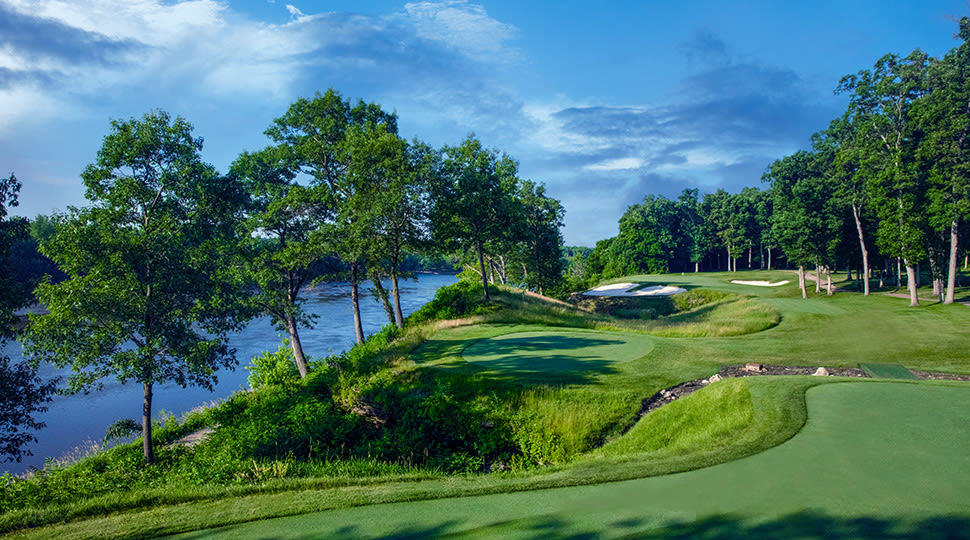
The 16th may be the signature hole. It is short, but the Rock River sits to the left and danger is very much part of the picture. It is a beautiful hole, but tournament beauty usually comes with a warning label.
No. 18: Conquistador
The closing hole puts a premium on driving accuracy. Players need length and shape, but they also need to favor the proper side to avoid the fairway bunker and create the right angle into the green. The 18th at TPC Deere Run has already produced plenty of John Deere Classic memories, and it is built to produce more.
Why TPC Deere Run Works
The best tournament courses have a personality. TPC Deere Run’s personality is not intimidating. It is inviting, but never soft. It rewards good golf, especially quality approach play, smart wedge control and confident putting. It also rewards players who understand when a green light is truly green and when it is only pretending to be.
For everyday golfers watching the John Deere Classic, that is a great lesson. You do not need U.S. Open rough or 500-yard par 4s to learn something about course management. Deere Run shows how much scoring comes down to angles, patience and picking the right moments to be aggressive.
The John Deere Classic feels like a community event because it is one. The tournament has raised more than $189 million for charity since its inception, and John Deere has extended its commitment to the event through 2030.
But inside all that hospitality is a golf course that still demands high-level decisions.
TPC Deere Run gives players a chance to make birdies. It gives fans a chance to see movement. It gives Sunday leaders a chance to win, and chasers a chance to believe.
That combination is why the John Deere Classic so often delivers exactly what a summer PGA Tour stop should: low scores, fresh names, big finishes and a golf course that lets the best player that week go prove it.
PGA of America Golf Professional Brendon Elliott is an award-winning coach and golf writer. Read his recent “The Starter” on R.org and his stories on Athlon Sports. To stay updated on his latest work, sign up for his newsletter and visit OneMoreRollGolf.com.