 Leaderboards
  Become a Member
  Shop
Shop  Trade In
 Course Spotlight
Planning a Golf Trip to Minneapolis? Play These 5 Fun Public Courses
By Chris Lewis
Published on
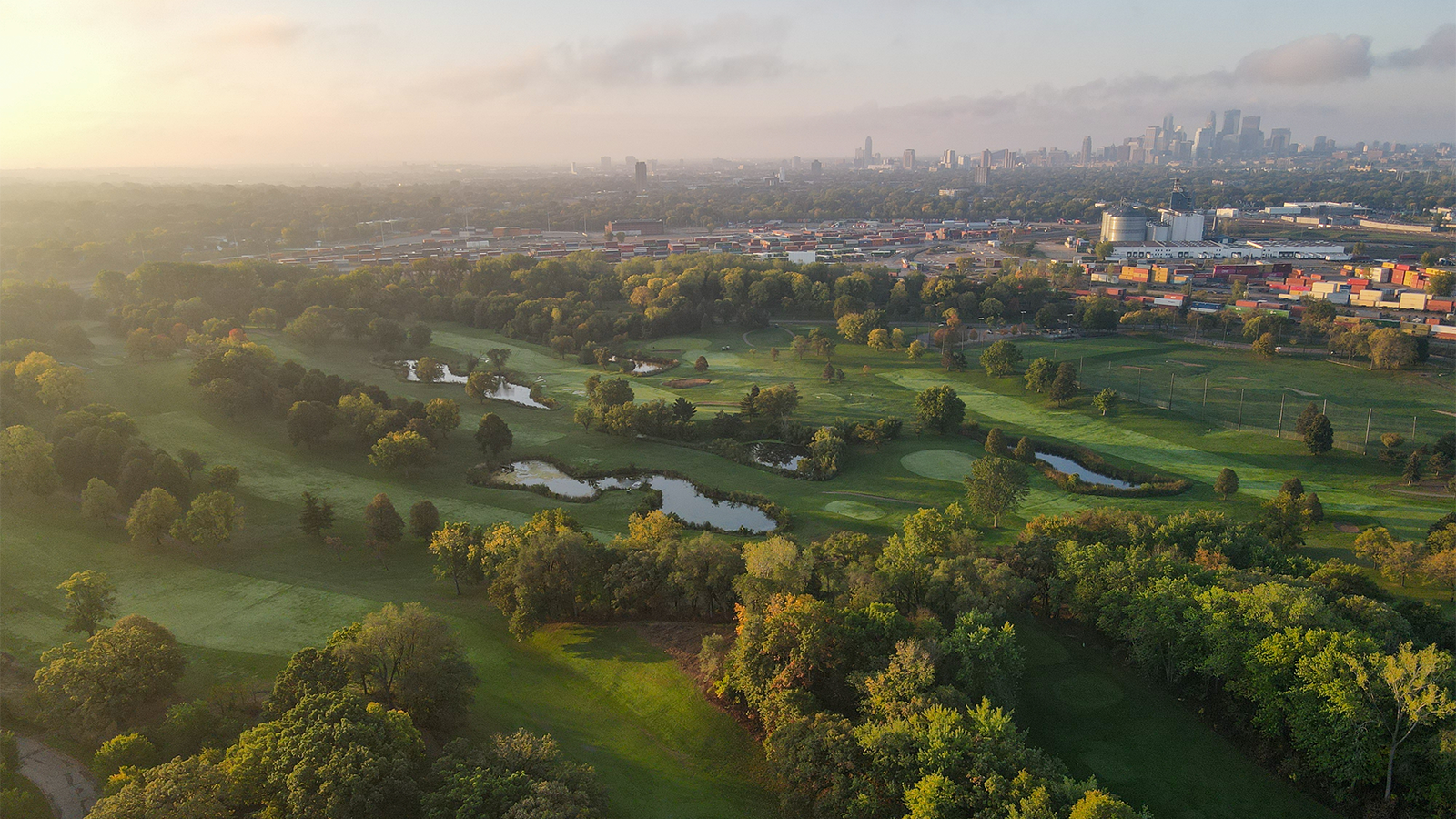
In 1916, Minneapolis hosted its first major championship. Since then, it has steadily hosted a variety of other majors, leading to many memorable moments—from Tony Jacklin’s victory in the 1970 U.S. Open, to Rich Beem’s and Y.E. Yang’s upsets in the 2002 and 2009 PGA Championships.
Once again, the spotlight is on Minneapolis, as it’s hosting yet another major championship, the 2026 KPMG Women’s PGA Championship. Although the championship’s host site, Hazeltine National, is a private club, the area has also become renowned for its public courses.
In fact, within 20 miles of downtown Minneapolis, you’ll discover more than 60 public courses to choose from. Here are just a few options for you to consider during your next trip to the Twin Cities.
Chaska Town Course, Chaska
A municipal golf course, Chaska Town Course has been a go-to destination for avid and newer golfers alike since it first opened in 1997. Perhaps its popularity is due to its designer, Arthur Hills, who created over 200 courses during his career. Or maybe its reputation is associated with its proximity to Hazeltine National, as it’s less than 10 minutes away from the historic club?
Whatever the reason, John Kellin, PGA, Head Golf Professional, believes the course continues to stand out to residents and tourists. In his opinion, golfers especially appreciate Chaska Town Course’s affordability, high quality and consistent customer service.
“It’s a great value for the overall experience,” he stressed. “Considering the course’s quality, our prices are very good.”
A co-host of the 2006 and 2024 U.S. Amateurs, alongside Hazeltine National, Chaska Town Course offers a private club vibe, too.
“Our guests are treated like they’re at a private club,” Kellin said.
Columbia Golf Club, Minneapolis
Located in Columbia Park, roughly 15 minutes from downtown Minneapolis, Columbia Golf Club has become a year-round “home” for the Twin Cities’ golfers. How so, you may ask? First, it offers 18 holes of championship golf in the spring, summer and fall. And then, when golfers want to escape the harsh winters, they can visit its indoor simulators, which are open throughout the year.
During the peak months of Minneapolis’s golf season, golfers have been frequenting the course for several reasons. Above all else, its holes provide considerable variety, challenges and city views.
“Because of the elevation changes, it’s very fun to play here,” said Aaron Shafranski, PGA, Teaching Professional. “Also, the 10th hole offers a backdrop of the downtown skyline that’s very picturesque, while the 16th hole is one of Minnesota’s most challenging par-fours.”
Various renovations have occurred lately as well, as the fairways on the 2nd and 16th holes were reshaped. Another tee box was added to the 16th hole too, while the 14th hole was transformed from a par-four to a par-three.
“Finally, Columbia has some of Minnesota’s best greens, which you need to see for yourself,” Shafranski added.
Edinburgh USA, Brooklyn Park
A suburb of Minneapolis, Brooklyn Park is home to one of only two courses in Minnesota that were designed by Robert Trent Jones II. Opened in 1987, Edinburgh USA certainly lives up to the reputation associated with other Jones II designs.
In particular, its conditioning is impeccable. According to Don Berry, PGA, Director of Golf, the course has never had widespread winter kill. Its turf has never been extensively damaged either. Berry believes both of these instances are extremely rare in the area, due to its harsh winters.
Furthermore, as is usually the case with Jones II designs, Edinburgh USA’s layout is “very enjoyable,” leading guests to travel from outside of Minnesota to visit it. But, above all else, the course is aging like a fine wine.
“It seems to always get better,” Berry emphasized. “I’ve worked here for 39 of the 40 years it’s been open to the public. Today, the course is the best it’s ever been—from an agronomy standpoint and an aesthetic perspective.”
Keller Golf Course, Maplewood
There are few courses in Minnesota, let alone the Twin Cities area, that have as much history as Keller Golf Course. After all, in 2029, the course will be celebrating its 100th anniversary. As the course—and its staff members—prepare for this milestone, golfers are steadily visiting it, as they’re especially interested in witnessing its history firsthand.
A step back in time, the course hosted the PGA Championship in 1932 and 1954. Additionally, it hosted the PGA Tour’s St. Paul Open from 1930 to 1968, the PGA Tour’s 1949 Western Open and the LPGA Tour’s Patty Berg Classic from 1973 to 1980.
“Its history definitely stands out,” said Mark Foley, PGA, Head Professional. “It’s really old school, as it’s not very long, so it will test your short game more than anything. There’s also only one hole that has houses on it, so it’s pretty secluded.”
Remodeled in the early 2010s for 21 months, Keller Golf Course’s layout has been fully modernized. Yet, its overall classic feel has been preserved as well.
“The remodeling has been fabulous,” Foley stated. “Our course is ready for the future, while also embracing its rich history as it prepares for the next 100 years.”
Rush Creek Golf Club, Maple Grove
When golfers arrive at Rush Creek Golf Club for the first time, they’re enamored by the entire property. Its sheer size. Its gorgeous scenery. Its pristine conditioning. It truly looks—and feels—like a private country club. Yet, it’s always been a public course, and will remain so, likely for many years to come.
“Rush Creek delivers a true championship golf experience while still being a public course,” said Tom Wall, PGA, Head Golf Professional. “There aren’t that many places that offer that combination.”
Aside from the club’s 18-hole championship course’s conditioning, its overall layout is noteworthy too, as it has a “lot of personality,” according to Wall, from its elevation changes, to its views, to its wetlands. Consequently, it “feels like a special place” to everyone that visits, whether they’ve never visited beforehand or they’re visiting for the 100th time.
The course was also designed with everyone in mind. It’s challenging and strategic enough for skilled golfers, yet it provides a variety of tee box options as well, ensuring newer golfers can play without feeling overwhelmed.
“At the end of the day, we want people to leave here already thinking about when they can come back and play again,” Wall added.